Jumping Castle Safety: What to Check Before You Book
4 min read

Jumping castle safety in Australia is not a marketing line, it's a set of specific, checkable things a supplier should be able to show you before you pay a deposit, and knowing what to ask for is the single best thing a hirer can do to protect the kids at their event. Inflatable amusement devices are covered by an Australian Standard, regulators actively enforce it, and the questions below come straight from what that standard and the regulators actually require.
Why this matters more than it used to
On 16 December 2021, a wind gust lifted a jumping castle and inflatable "zorb balls" at an end-of-year school event in Devonport, Tasmania, and six children died. The tragedy triggered a genuine tightening of enforcement around the country: Victoria ran 380 inspections of community-event inflatables in 2024 alone and found recurring problems with anchoring, unweathered electrical blowers and supervision, and Queensland introduced a dedicated Code of Practice for amusement devices that took effect from February 2024. Whatever the outcome of the ongoing coronial inquest, the practical result for hirers is that asking these questions is now completely normal, and a supplier who can't answer them plainly is not one to book.
The standard that governs inflatables
The core document is AS 3533.4.1, Amusement rides and devices, Part 4.1: Specific requirements, Land-borne inflatable devices. It sets requirements for design, anchoring, operation and maintenance of jumping castles, inflatable slides and obstacle courses. It's a supplier obligation, not something a marketplace or a hirer polices, but knowing it exists is what turns "looks fine to me" into an actual question you can ask.
What to check before you book
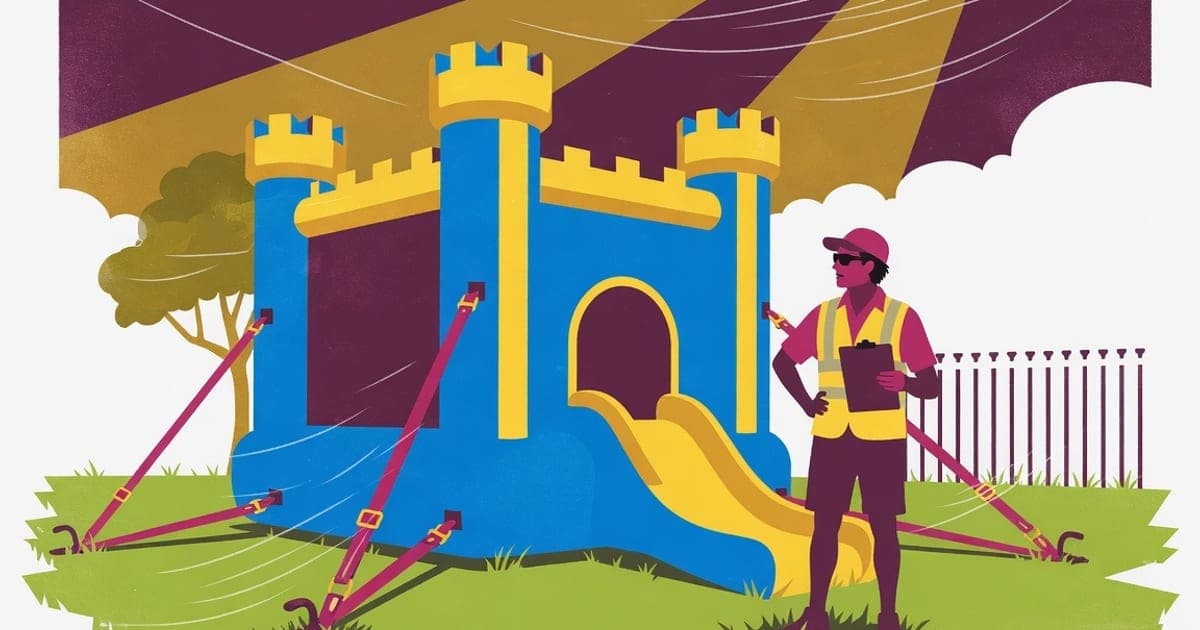
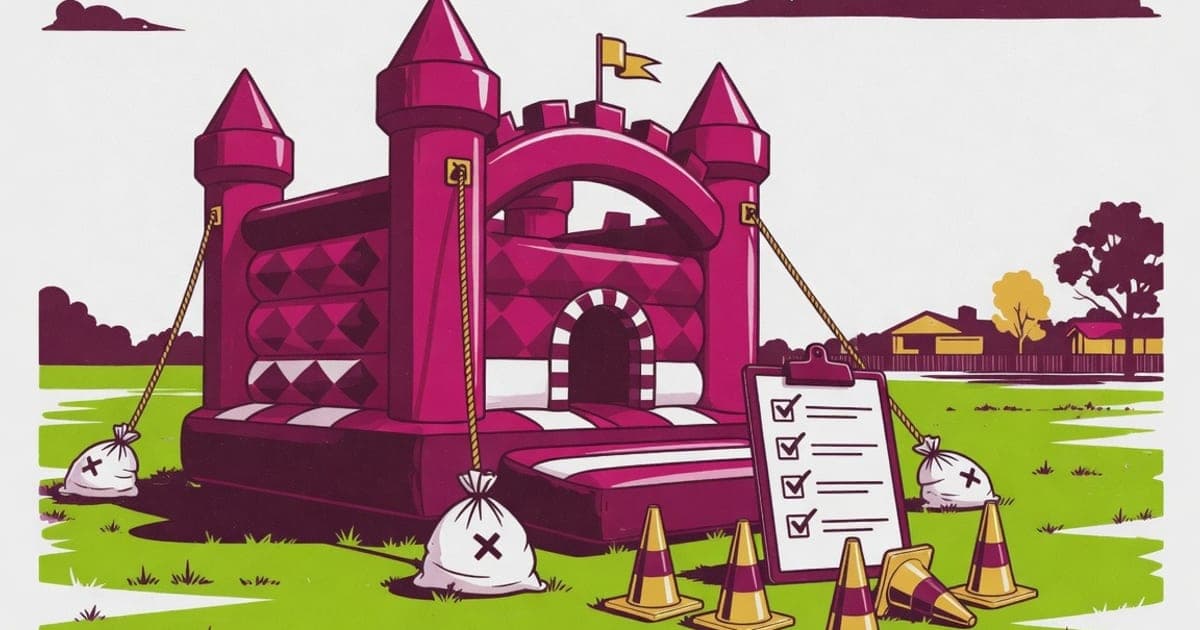
Anchoring. AS 3533.4.1 sets minimum anchor strength and anchor count based on the device's size, and a commonly cited figure is that each ground anchor point needs to resist a load in the order of 1,600 newtons, roughly 163 kilograms. On grass or soil that means proper stakes driven to depth, not decorative pegs; on paving, concrete or any hard surface it means ballast or weights suited to the device, because stakes simply can't do the job there. Ask what the anchoring plan is for your specific surface before the day, not on it.
Wind. Regulators direct operators to stop use, deflate and evacuate an inflatable once wind gusts exceed the manufacturer's stated limit or 40 km/h, whichever is lower, and to have a wind-monitoring plan in place, ideally with an on-site anemometer. Ask your supplier directly: what's your wind limit for this device, and how will you know when it's been reached? A supplier with a real answer has clearly done this before.
Supervision. A jumping castle should be supervised at all times by a competent adult, not left running unattended with children on it, with rider numbers, weight and age limits enforced against the device's own rating plate. This is the cheapest safety measure of all and the easiest to skip when a party gets busy, so agree beforehand who's responsible for watching the castle.
Inspection and log book. Operators are expected to keep a log book covering service history and who's installed or operated the device, and to have it inspected annually by a competent person. Queensland's 2023 Code of Practice made this explicit with a formal log book handover requirement; other states run broadly equivalent regimes under their WHS Acts. Ask to see evidence of the most recent inspection. A supplier who can produce it without fuss is telling you something real about how they run their business.
Electrical safety. The blower that keeps the castle inflated is mains-powered equipment and should carry a current, unexpired test tag under AS/NZS 3760, the same standard covering any electrical item for hire. Blower cords sitting in wet grass, run through a puddle, or plugged into an extension lead with no RCD protection are exactly the setup issues Victoria's 2024 inspection blitz flagged repeatedly. If you're supplying power yourself rather than relying on the operator's own setup, our guide on whether you need a generator for your event covers safe power basics too.
Public liability insurance. Ask for a current Certificate of Currency, the standard proof document showing insurer, policy number, cover limit and expiry date. Typical cover for Australian party and event hire suppliers runs $5 million to $20 million, with $10 million and $20 million the two figures most councils and venues ask for. This is reasonable to ask for on any inflatable hire, and a supplier who can produce it readily has almost certainly done the rest of this list too.
Rain, heat and the practical stuff
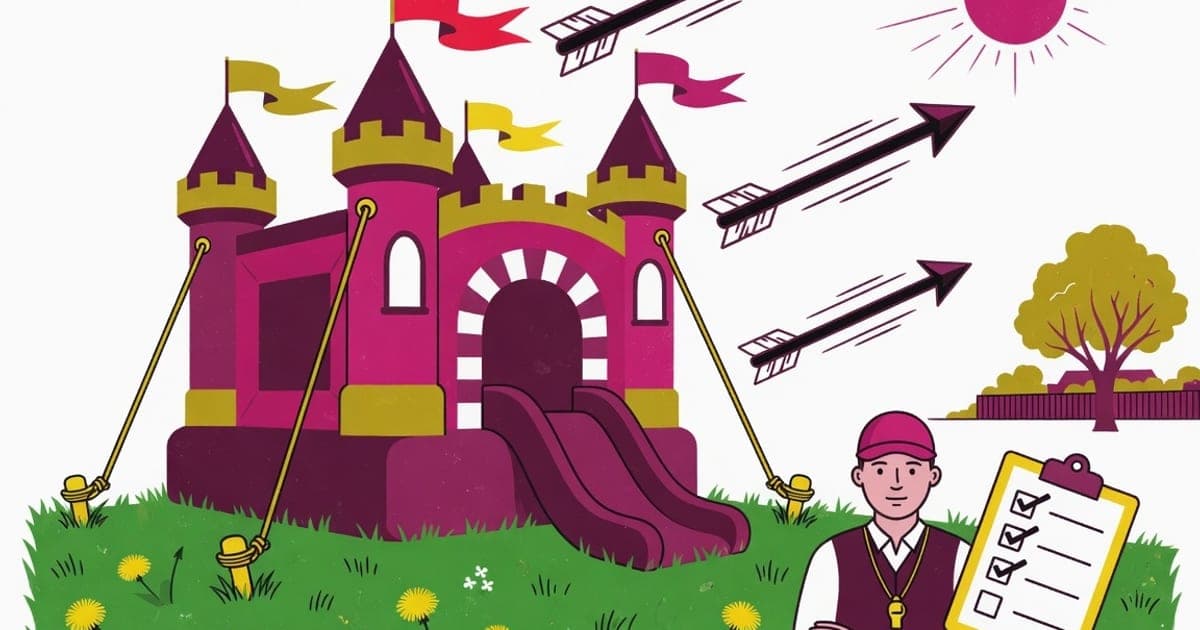
Beyond the formal checklist, ask what happens if it rains on the day (most inflatables are pulled from a wet or storm-affected booking rather than run in the rain), how the castle is cleaned between hires, and whether shade is provided or recommended for hot days, since the vinyl surface gets genuinely hot in direct Australian sun.
What this checklist doesn't cover
None of this replaces reading the specific operator's own safety brief on the day, and none of it is legal advice; it's a starting point for the conversation with your supplier. Party Hire Near Me is a classifieds marketplace, not the operator, the inspector or the insurer of any inflatable listed here, and we don't verify test tags, inspection records or insurance before a listing goes live. Ask directly, and if a supplier can't produce straightforward answers to the questions above, that's the clearest signal there is. See what jumping castle hire actually costs once you've found operators who check out, and browse jumping castles and inflatables for hire to compare listings near you.
For a current look at this, see our guide on AS 3533.4.1: Inflatable Safety Rules for Australian Hirers.